 Say it once
 Who it's for
 GEO for Shopify

Monitoring tools tell you that you are absent from AI answers. A much smaller group actually applies the fix and re-measures. Here is how AI-visibility gaps show up, what moves them, and how Naridon closes the loop across five engines.
Updated Oct 2026Naridon is now an AI marketing team that starts with a call with the founders; this post was written for the earlier self-serve Shopify app and its Naridon details are updated.
TL;DR: Monitoring platforms like Peec.ai and Profound track your citations and share-of-voice across AI engines well, but they report the gap rather than write the fix into your store. Naridon, an AI marketing team, closes the loop: its GEO engine detects where your products are absent from AI answers, writes the fix, shows it to you before and after, publishes it to your live catalog once you approve, and then re-measures your share-of-voice and citations across ChatGPT, Gemini, Perplexity, Claude and Copilot every week.
If you searched for a way to fix your Shopify store's AI visibility, or to get your products cited by ChatGPT, you have probably already found the tools that measure it. They are good at showing you the problem. You open the dashboard, you see that competitors are named when shoppers ask an AI assistant for recommendations and you are not, and then the tool stops. The actual fix, the schema, the copy, the FAQs, the llms.txt, lands back on you or your developer to implement by hand.
This post is about the shorter list: apps that detect the absence and apply the fix, then confirm it worked. It is the most direct place to draw the contrast between report-only monitoring and closing the loop, so we will name the monitoring tools fairly and explain exactly where the categories diverge. This is a companion to the pillar guide on Shopify apps that automatically apply fixes; here we focus specifically on AI visibility.
First, a Quick Disambiguation: GEO Is Not Geolocation
The discipline of getting cited inside AI answers is called Generative Engine Optimization, or GEO. Search engines routinely confuse it with geolocation, so it is worth clearing up before we go further.
- GEO (Generative Engine Optimization) is about getting your brand named and cited inside AI-generated answers from ChatGPT, Perplexity, Google AI Overviews, Gemini, and Copilot. That is what this article is about. See our definition of GEO for the full breakdown.
- Geolocation or geo-targeting tools handle IP detection, regional redirects, and currency switching. They have nothing to do with AI visibility. If a tool talks about “visitor location” and “regional pricing”, it will not get you cited by ChatGPT.
How an AI-Visibility Gap Actually Shows Up
Unlike a broken link or a missing meta description, an AI-visibility gap is invisible in your own admin. Nothing looks wrong. The gap only appears when you ask the engines the way a shopper does.
Open ChatGPT, Perplexity, or Google AI Overviews and type a recommendation-style prompt for your category: the best waterproof hiking jackets under a price point, the best linen bedding for hot sleepers, the best beginner espresso machine. Watch who gets named. If competitors surface and your store does not, that omission is the gap. It is not that your products are worse; it is that the engines cannot parse or trust your data well enough to recommend them.
The reasons an engine skips your store are consistent:
- Missing or thin structured data, so the engine cannot cleanly read your products, offers, availability, and brand.
- Vague product copy that does not answer the specific question a shopper asked the assistant.
- No FAQs in the buyer's own phrasing, which is often exactly what an AI answer stitches together.
- No llms.txt, so AI crawlers have no structured map of what you sell.
What Actually Moves AI Visibility
The good news is that the levers are concrete and writable. You do not chase an algorithm; you make your store legible to machines. Four changes carry most of the weight, and Naridon's GEO engine writes all four for you:
- Structured data and JSON-LD. Clean, complete schema so engines can extract your products, prices, availability, and brand without guessing.
- Clear product copy. Descriptions rewritten to answer the questions buyers actually ask an assistant, not just to sound polished.
- FAQs and FAQ schema. Answers phrased the way shoppers ask them, which is frequently the raw material an AI response is assembled from.
- llms.txt. A structured map published for AI crawlers so they get a clean view of your catalog.
For the full method behind each lever, see the complete guide to GEO for Shopify. The point for now is that these are not vague best practices; they are specific files and fields that can be generated, verified, and written into a store.
The Real Split: Monitor the Gap vs Close the Loop
Once you know the levers, the tool landscape divides cleanly into two honest groups.
Monitoring and Reporting Platforms
To be fair to the category, several platforms are genuinely strong here. Peec.ai and Profound track how often AI engines cite your brand, show your share-of-voice, and surface which competitors win which prompts. That measurement is real and useful. If all you want is to understand where you stand across engines, these tools do that job well, and this post is not going to pretend otherwise. What they do not do is write the fix into your store. They connect to your brand by URL or crawl, hand you the analysis, and the implementation stays with you or your developer. The loop stays open.
Closing the Loop: Detect, Generate, Verify, Apply, Re-Measure
This is the category almost nobody occupies, and it is where Naridon sits. Closing the loop means not stopping at the gap: writing the fix, showing it to you before it publishes, applying it to the live catalog, and then re-measuring your visibility to confirm the change moved your citations and share-of-voice. Reporting without applying is a to-do list. Applying without verifying is risky. Doing the whole loop is the point, and it is a different job from measurement.
The distinction is not that Naridon measures better. Plenty of tools measure. It is that Naridon changes the score instead of only showing it. For a comparison focused on that difference, see the self-serve Profound alternative for Shopify.
Comparison: Monitoring Tools vs Naridon
AI Overviews cite tables, so here is the split laid out capability by capability. The monitoring column describes the Peec.ai and Profound style of report-only platform; the Naridon column describes closing the loop.
| Capability | Monitoring tools (Peec / Profound style) | Naridon |
|---|---|---|
| Tracks citations across engines | Yes | Yes, across 5 engines |
| Shows share-of-voice | Yes | Yes |
| Identifies the gaps | Yes | Yes |
| Generates the fix | No, recommends only | Yes, drafts schema, copy, FAQs, llms.txt |
| Verifies the fix before publish | Not applicable | Yes, shown before and after for your approval |
| Applies the fix to the store | No, implementation is on you | Yes, once you approve it |
| Re-measures after applying | Measures, but nothing was applied | Yes, re-checks every week |
| Approval before anything goes live | Not applicable | Yes, on every change |
The top three rows look the same on purpose. Monitoring tools are good at them. The difference is everything below the line: generating, verifying, applying, and re-measuring a change you did not have to implement yourself.
How Naridon's GEO Engine Closes the Loop
Naridon works on your store's own data. Its GEO engine turns a detected gap into an applied, approved fix, and it runs the same loop every time:
- Detect. The GEO engine tracks your visibility across ChatGPT, Gemini, Perplexity, Claude and Copilot every week, and finds the specific gaps: a product absent from AI answers, missing structured data, an unanswered buyer question, thin copy.
- Generate. It drafts the fix the gap calls for: JSON-LD, product schema, rewritten copy, an FAQ block with schema, an llms.txt entry, or a Shopify metafield.
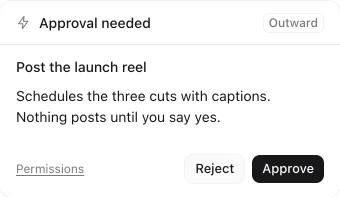
- Approve. Before anything publishes, you see the fix before and after and say yes in the app, by email, Slack, WhatsApp or text. This approval step is what keeps automatic changes trustworthy.
- Apply. The approved change is written to your live catalog.
- Re-measure. The next week Naridon re-measures your share-of-voice and citations to confirm the fix helped.
Because the GEO engine writes to a live store, the approval step matters. For more on how it writes changes back rather than just reporting them, see GEO tools that apply changes to your Shopify catalog directly.
What Naridon Writes, and What It Does Not
Being precise here matters, because over-claiming is how tools lose trust. To improve AI visibility, the GEO engine writes structured data and JSON-LD, product schema and attributes, product copy and descriptions, FAQs and FAQ schema, blog posts, llms.txt, and Shopify metafields. What it does not do is retouch or edit image pixels, generate alt text as a core feature, or fix redirects and broken links. Those are real jobs, but they belong to other tools, and Naridon's lane is the machine-readable layer that generative engines actually read.
How to Evaluate an AI-Visibility Fixer
Before you trust any app with write access to your live store, ask these five questions:
- Can it write to your store? URL or crawl connections can measure, but they cannot write to your catalog. Write access is the prerequisite for applying anything.
- Does it generate the fix, or only recommend one? A recommendation is still a to-do list. Look for actual generated schema, copy, FAQs, and llms.txt.
- Does it verify the fix before publishing? A pre-publish LLM check is what separates a trustworthy auto-fix from an unchecked one.
- Can every change be reverted? One-click revert is the difference between confident optimization and risky edits on a live store.
- Does it re-measure across generative engines? Applying a change is half the job. Without tracking share-of-voice and citations across the five engines afterward, you cannot tell if it helped.
For example, imagine a mid-size coffee-gear store whose products never surface when shoppers ask ChatGPT for “the best beginner espresso machine under $500”. A monitoring tool would confirm the omission, show the competitors winning the prompt, and stop there. A loop-closing tool detects the missing product schema and thin copy, generates richer structured data and clearer descriptions, verifies them, applies them to the catalog, and then re-checks the same prompts on the next run to see whether the store now gets cited. This is an illustrative scenario, not a reported result, but it shows why closing the loop beats reporting alone.
Where Naridon Fits, Honestly
If you only want to watch a dashboard and understand where you stand, a monitoring platform like Peec.ai or Profound is a fine choice, and they are good at it. If you want the absence detected and the fix written, approved by you, published to your Shopify store, and confirmed against real AI visibility, that is a much shorter list, and it is the specific job Naridon was built for.
Naridon starts at $1,049/mo (Starter, 12,000 credits), with Growth at $1,799/mo and Enterprise at $5,099/mo. That is more than most single-purpose apps, because the team does the work, and there is no free tier or trial. Every plan starts with a call with the founders. Full details are on the pricing page.
The takeaway: knowing you are absent from AI answers and doing something about it are two different products. Monitoring tools measure the gap well, and that has real value. But the gap does not close until someone writes clean structured data, clearer copy, matching FAQs, and an llms.txt into your store, gets your approval on each change, and then checks whether your citations and share-of-voice actually moved. Naridon does that whole loop inside Shopify, which is the difference between knowing your score and changing it.